
My PhD dissertation examined Thai Constitutionalism (legal doctrines, texts, case-law, and overall ‘constitutional culture’) in a historical, comparative and critical perspective, deconstructing the bricolage of Thailand’s concept and practice of royal sovereignty.
In 2016, the early paper summarising my findings was awarded the 1st Prize of the Young Constitutional Law Research by the French Association of Constitutional Law (AFDC -Association Française de Droit Constitutionnel).
In 2018, the original dissertation was awarded the “Prix de thèse de l’Institut Universitaire Varenne” (Category : Comparative Constitutional Law) and “Prix honorifique Lévy-Ullmann” (Category : Law & Politics) of the Universities of Paris (Prix de thèse de la Chancellerie des Universités de Paris).
Initially written in the French language, it was published or is currently under publication in French, English and Thai as shown below, and hopefully, soon a Japanese and a Chinese translation.

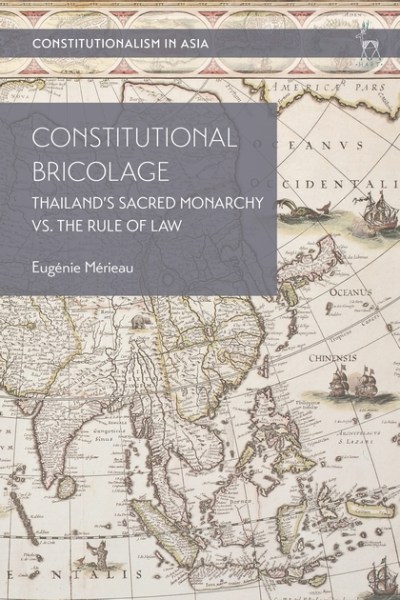
- รัฐธรรมนูญนิยมไทย : ว่าด้วยประชาธิปไตยอันมีพระมหากษัตริย์ทรงเป็นประมุข (Bangkok : Fa Diao Kan, forthcoming 2024)
No cover yet
—— BOOK REVIEWS :
– Tyrell Haberkorn, Law and Social Inquiry, 2024
“Eugenie Mérieau’s Constitutional Bricolage: Thailand’s Sacred Monarchy vs. The Rule of Law brilliantly intervenes into a crisis that is as much analytic as it is political and legal. Combining six years of field research with incisive analysis of an impressive range of materials including draft meeting minutes, textbooks, and court decisions, Constitutional Bricolage changes both what we know about law and monarchy in Thailand and how we know it. Mérieau’s careful deconstruction of the intertwining of monarchy and law is an urgent contribution to the defense of rights and sovereignty.”
– Sanjayan Rajasingham, American Journal of Comparative Law, 2024
“Eugénie Mérieau offers us a rich, theoretically sophisticated account of Thailand’s constitutional order. A wealth of knowledge about Thailand, years of immersion, and access to materials in all the languages of her subjects (English, Thai, French, and German) make her work unique—this is an outstanding history of constitutions.”
– Khemthong Tonsakulrungruang, International Journal of Constitutional Law, 2023
“Eugenie Merieau is known for her series of studies on Thai constitutional law, ranging from the deep state theory to the 1932 constitutional compromise, from the lèse majesté to Buddhist kingship. Her new book, Constitutional Bricolage: Thailand’s Sacred Monarchy vs. the Rule of Law, is an epitome of her previous works. The book fascinates readers with years of research as well as first-person observation of Thailand’s fragile constitutions and constitutional scholars.”
– Paul Chambers, Pacific Affairs, 2023
“This book is unprecedented in examining how laws about monarchy, derived from Hindu-Buddhism, became enmeshed in Western conceptualizations, ultimately resulting in legal, hybridized bricolage. Another strength is the author’s rich use of Thai and nonThai sources in writing this book. Finally, the author’s ability to show how Thailand’s constitutional court rose from a strong judicial body to become a substitute king is novel. The book would be a good read for students of comparative constitutionalism and/or Thai studies. Sometimes it seems a bit dense, with palace-backed constitutions appearing perhaps overly deterministic. But as a work that explains in depth the evolution of monarchical domination over Thailand’s various constitutions, it is unsurpassed.”
– Frank Munger, Asian Journal of Law and Society, 2022
“Constitutional Bricolage develops the author’s thesis through detailed accounts of debates over constitutional language, examination of the intentions of actors who influenced constitutional thought through reinterpretation of constitutionalism’s most important norms. Mérieau constructs, era by era, a “constitutional ethnography,” a “layered narrative” of the collective, dialectical, and often chaotic process of purposeful misreading, and “reassignment” of ideas to serve new functions by “active and often strategic participants” who legitimize power, not only the constitution-drafters, but also scholars, judges, and other political actors. Constitutional norms that emerge from this process comprise an eclectic mix of reinterpreted elements from Thailand’s remembered past and European constitutional practice. The resulting constitutional bricolage, or patchwork of repurposed borrowings, arose from successive political compromises between monarchical traditions and foreign ideals, each with legitimating force. In the debates over these ideas, the monarchy’s prerogative powers were never far from the centre of debates.”
– Rawin Leelapatana, Contemporary Southeast Asia, 2022
“The book is an enjoyable read and represents the most comprehensive analysis to date of the impact that foreign legal conceptual transplants have had on Thailand’s constitutional topography. For those interested in Thai legal history, it offers detailed insights into the interplay between the monarchy, the rule of law and constitutionalism in Thailand.”
– Kongsatja Suwanapech, Thai Legal Studies, 2022
“In conclusion, “Constitutional Bricolage” offers a comprehensive understanding of Thai constitutional history through contextual legal studies. Legal doctrines are vividly put into context through the framework of bricolage. Legal scholars are engaged to think beyond functional and Eurocentric approaches. The book has also succeeded in overcoming the dichotomy between the civil and common legal traditions in which Thai scholars have been deeply entrenched for decades. Thanks to constitutional bricolage, the Thai legal system now reflects a pluralistic imagination—a shift that has been long overdue.”
– Metus Manasthaworn and Nanmanat Klomkliang, Nitiparirat Journal, 2022
– Khemthong Tonsakulrungruang, Journal of Siam Society, 2022
Watch the Replay of the Book Launch, hosted by the Centre for Asian Legal Studies, National University of Singapore, with Thongchai Winnichakul, Tom Ginsburg, Andrew Harding, and Khemthong Tonsakulrungruang, moderated by Dian Shah here
Listen to the Podcast New Books in Southeast Asian Studies, hosted by the New Books Network, Interview by Duncan Mc Cargo here
 Eugénie Mérieau